
AI is changing the world - but it won’t replace Counsellors
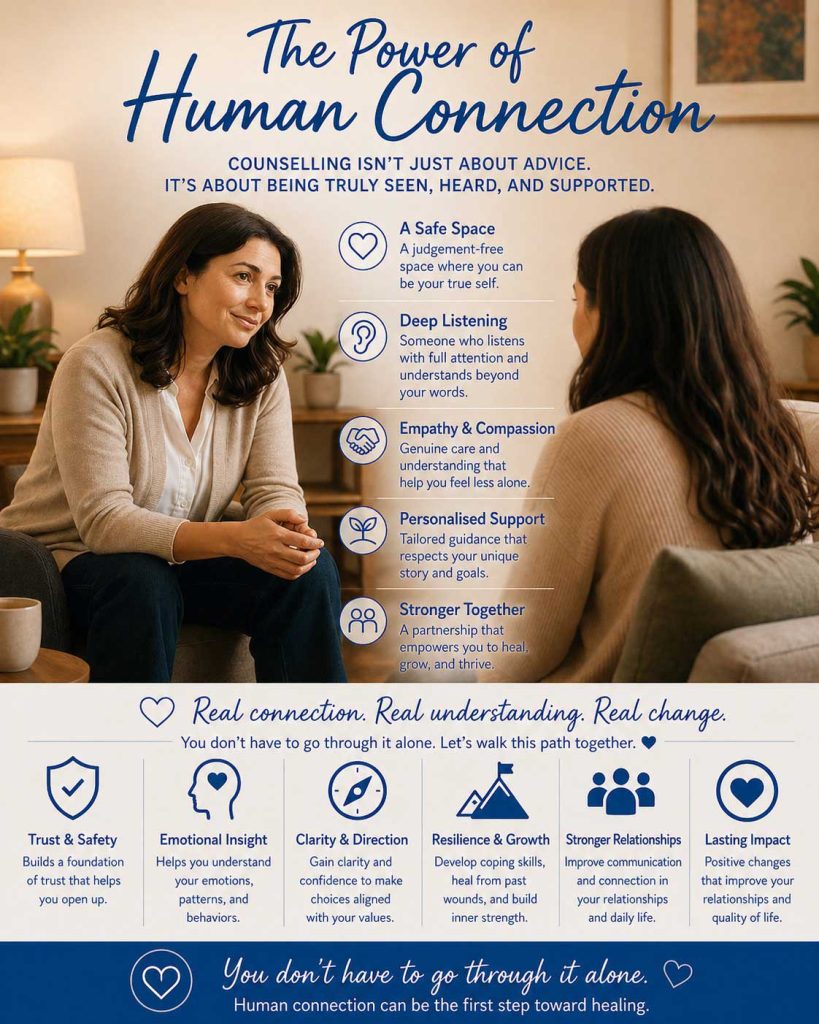
In a world where artificial intelligence is rapidly transforming industries—from customer service to healthcare diagnostics—it’s natural to wonder what roles will continue to depend on genuine human connection and lived experience. For those considering a career change, a common question arises: Will AI eventually replace this role?
For Counselling the short answer is no. While AI tools may support aspects of mental health care, the role of a counsellor is fundamentally rooted in human connection, empathy, emotional guidance, and ethical responsibility—qualities that cannot be replicated by machines.
Counselling Is Built on Human Relationship
At the core of effective counselling is the therapeutic relationship. Decades of research consistently show that the quality of the relationship between counsellor and client is one of the strongest predictors of positive outcomes. Trust, rapport, empathy, and genuine presence are not simply “features” of counselling—they are the work.
AI can simulate conversation. It can even be programmed to respond with empathetic language. But it does not feel empathy. It does not sit with a client in shared emotional space, intuitively adjusting tone, timing, and presence based on subtle cues like body language, silence, or emotional shifts.
Clients are not just seeking information or advice. They are seeking to be seen, heard, and understood by another human being. That experience cannot be authentically replaced by an algorithm.
Emotional Intelligence Cannot Be Programmed
Counsellors rely heavily on emotional intelligence—the ability to perceive, interpret, and respond to complex emotional states. This includes recognizing contradictions between what a client says and what they feel, understanding cultural and relational context, and responding with nuance.
AI operates on patterns and data. It does not possess lived experience, intuition, or the ability to interpret meaning beyond what it has been trained on. While it can identify keywords or sentiment, it cannot truly understand grief, trauma, shame, or hope in the way a human can.
A counsellor draws not only from training, but from personal growth, supervision, and lived experience. This depth allows them to sit with ambiguity, navigate complex emotional dynamics, and support clients through deeply personal transformations.
Ethical Responsibility Requires Human Judgment
Counsellors are bound by ethical frameworks that require critical thinking, accountability, and professional judgment. Situations involving risk—such as suicidal ideation, abuse, or crisis intervention—require immediate, context-sensitive decisions that prioritize safety and well-being.
AI does not hold ethical responsibility. It cannot be accountable in the same way a trained professional is. It cannot assess risk in real time with the depth required, nor can it take responsibility for outcomes.
In counselling, decisions are rarely black and white. They require discernment, consultation, and often a deep understanding of the individual client’s history and context. This level of responsibility must remain in Counsellors hands.
Healing Happens Through Shared Experience
One of the most powerful aspects of counselling is the experience of not being alone. Clients often come to counselling feeling isolated in their struggles. The presence of another human—someone who is fully engaged, compassionate, and non-judgmental—creates a space where healing can begin.
AI cannot share in that experience. It cannot offer genuine connection or mutual presence. Even the most advanced systems are ultimately tools, not participants in a human relationship.
Counsellors also model healthy relational dynamics. Through the therapeutic relationship, clients learn boundaries, communication skills, and emotional regulation. These are relational skills that must be experienced, not just described.
The Growing Need for Human Counsellors
As society becomes more digitized, the need for authentic human connection is increasing, not decreasing. Many individuals are already experiencing the emotional impact of technology—disconnection, loneliness, and reduced face-to-face interaction.
This creates a greater demand for skilled counsellors who can provide grounded, human-centred support.
In Canada and beyond, mental health needs continue to rise and communities require compassionate, well-trained professionals.
A Profession Rooted in Humanity
Choosing to become a counsellor is not just a career decision—it is a commitment to supporting others in meaningful and transformative ways. It requires presence, self-awareness, and a willingness to engage deeply with the human experience.
These are not qualities that can be automated.If you’re considering a path in counselling, you can move forward with confidence knowing that your role will remain not only relevant—but essential.
At KCPC, we believe in preparing students for a profession that is both timeless and evolving. While tools and technologies will continue to change, the essence of counselling remains the same: one human being helping another navigate life’s challenges with compassion, skill, and integrity.